
Friday Forward - False Safety (#537)
Parents are making safety decisions based on anxiety, not reality

Just as I was about to send the final manuscript of my next book, Elevate Your Kids, to my publisher last week, a new study arrived with impeccable timing. It empirically addressed the paradox that prompted me to write the book.
The study, from the Institute for Family Studies, surveyed nearly 24,000 American parents about how they raise their children. One shocking chart plotted the percentage of kids at each age, from four to 17, who are not permitted to leave their house, their yard, their street, or their neighborhood without an adult.
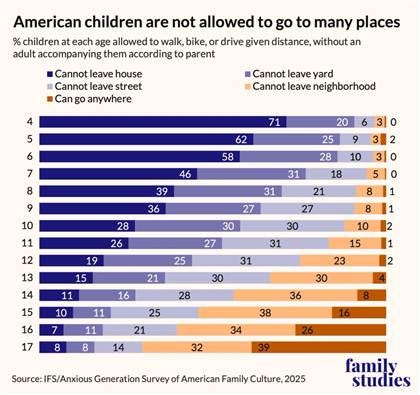
At age seven, nearly half of kids are not allowed to play in their own backyard unsupervised, and 77 percent can’t play in a neighbor’s yard. At 10, 88 percent can’t leave their street without an adult. At 17, on the doorstep of legal adulthood, 61 percent are forbidden to leave their neighborhood without one.
But it gets worse. The study showed that while parents are restrictive in the physical world, they are quite lax about the digital one.
By age 11, more than 60 percent of American kids have a smartphone, generally with few parental restrictions. Nearly half of three-year-olds routinely use a tablet.
The average twelve-year-old can’t bike to a friend’s house but can stream eight hours of TikTok in their bedroom. A sixteen-year-old isn’t trusted to walk to the store but has free access to an algorithmic feed engineered to keep them scrolling for hours, regardless of what it does to their brain.
Jonathan Haidt calls these shifts the great rewiring of childhood. Walks to the corner store or a friend’s house built a generation of capable, independent adults, but are forbidden today. There’s no real evidence these activities are particularly unsafe or have become more dangerous. The odds of a child being abducted by a stranger are roughly one in 720,000. According to Warwick Cairns, author of How to Live Dangerously, you’d have to leave a child unattended on the street for roughly 750,000 years for an abduction to be statistically likely.
Parents are making safety decisions based on anxiety, not reality.
Yet, these same parents hand their kids the very screens proven to harm them, and rarely set limits on how they’re used. Teen depression and anxiety have roughly doubled in a decade, and even the court system is now recognizing social media’s responsibility for a fair share of that harm.
These two trends create a vicious cycle. A child who can’t walk to a friend’s house will text that friend instead. A teenager who cannot leave their neighborhood will spend all weekend playing video games in their basement. Take away the analog options and the digital ones fill the vacuum. Physical isolation and digital addiction fuel each other.
Good intentions aside, it would be a fundamental failure of leadership at home to ignore these outcomes. Effective leaders act based on results, not popularity or convenience, and change course when evidence says the current approach is failing. In the most important leadership role most of us will ever have, too many parents have let their love for their kids blind them to what is healthy and what is detrimental to their development.
Don’t ignore the data just because so many other parents are making wrong choices as a crowd. The kids in the IFS survey are not “safer” than the generations before them. They are more anxious, more depressed, less capable of independent decisions, and reaching adulthood unequipped to manage their own lives. We have given them the wrong freedoms and the wrong constraints, and the results are clearly negative.
Elevate Your Kids is still a year away, and I hope it will present a helpful framework to understand how we got into this mess and how parents can use timeless leadership principles to begin to turn the tide. But I wouldn’t wait that long to start making changes. Let your kids walk to school. Let them order their own food at the restaurant. Let them figure out the bus. Let them play outside. Let them be bored, which is when most of the good stuff in childhood actually happens.
The data tells us clearly what’s gone wrong. Only effective leadership at home can make it right.
Quote of the Week
“We have overprotected our children in the real world and underprotected them online.” – Jonathan Haidt
Have a great weekend!
-Bob
New From Premium
excellent post on a topic that needs reframing of what safety really means...thank you
As a parent of course you worry. If
You’re scared they will be abducted, well my kids took Krav Maga for years…